
About Martin
My name is Martin Bartels, and my journey has spanned the realms of law, sociology, banking, and asset management. After two decades in the financial sector, I embarked on a consulting career, enriching my expertise and perspectives.

 Martin Bartels
Artificial Intelligence is the current stage of an age-old process, the simplification and automation of work. This has mostly had a disruptive effect, triggering social tensions by making jobs redundant. But it has also led to the creation of new ones.
More than 70% of the Earth's surface is covered by water. The oceans are vast and extremely deep in many places, making them an attractive place to dispose of things we would rather not think about.
The widespread enthusiasm about the ease with which we can now obtain and intelligently process information with the help of AI is often mixed with fears of losing one’s job: “Gen Z job-pocalypse”. Panic does not help. So, we need to take a more nuanced approach to looking at the professional landscape and the extent that these fears are founded. This article endeavours to describe trends that are likely to be valid for at least a few years.
The perception of rapid progress in the development of AI suggests that we should expect to see all-encompassing AI very soon, which would render human involvement in work processes, including innovation, superfluous. Artificial General Intelligence (AGI) would imply that machines are capable of formulating, questioning, modifying and guiding bold hypotheses towards usability through highly abstract thought processes based on deep theoretical insight and knowledge of sophisticated experimental methodologies.
In a nutshell, an example of AGI would be machines that were capable of developing mRNA drugs. They are currently not able to do this.
Artificial General Intelligence is not an empirical fact or a basis for substantiated conclusions but an expectation “symptomatic of a broader cultural and ideological struggle“. It is not a basis for substantiated conclusions. The issue may become relevant at some point, most likely at a gradual pace. However, this is not a basis for discussion at present. Therefore, we will not include this expectation in our discussion. What we will discuss is the current state of AI and its already substantial ability to alter the economy and workplace.
AI can be and is used as an argument for firing employees. Companies may use milder-sounding terms such as ‘advanced technology’ and ‘cobot’. Yet such labels do not necessarily correspond to reality.
The true reason may be the expectation of an imminent (and not AI-related) economic contraction phase. There may also be combinations of both motives.
However, companies that think strategically will do their utmost to avoid layoffs as far as possible in view of the demographic-driven shortage of skilled employees that is now becoming obvious. We have seen such forward-looking decisions during the Covid crisis.
Substantial industrial innovations are indeed likely to trigger structural shifts in the labour market, but they do not automatically reduce the demand for human resources. This can be illustrated by a historical example:
Daimler Motoren Gesellschaft (DMG) was founded in Cannstadt in 1890 and initially developed railcars with internal combustion engines (‘Daimler-Wagonnet’), intended to be an alternative to trains with steam engines. Then came the impetus for ‘horseless carriages’, and in 1896 the world's first combustion engine-powered lorry was launched.
The ‘Mercedes’ brand name was registered in 1902, and the automobile production started in 1907. It may have seemed that horse-drawn carriage manufacturers would become redundant. In fact, however, the carriage builders` centuries old expertise was needed to design vehicles for the automotive industry. The automakers' innovations were combustion engines, so they went for a symbiosis with carriage makers.
Expertise in building sturdy vehicles continued to develop, and carriage manufacturers became a mainstay of the automotive industry for many decades. In 2018, the fifth generation of the “Lueg carriage builders” family, now active in the high-end car trade, celebrated the 150th anniversary of their thriving company together with board members of Mercedes-Benz AG.
Similar ties between old and new developed on both sides of the Atlantic, supporting massive industrial advances. It is true that most carriage builders were unable to keep up, and there were market shake-ups, but their sector as a whole remained stable for many years.
The commitment to a merger of traditional technical expertise with powerful new developments in industry gives economies a boost and reaffirms Joseph Schumpeter's classic model of ‘creative destruction’. Similar historical patterns can be found in other leading sectors like mechanical engineering, electrical engineering or chemistry.
We can conclude that it is not in the interest of an evolving industry to destroy what it needs for its further development, but rather to include complementary expertise in new value chains. This may cause unrest among the legacy players, but they can grow well if they join the new value chain with continuity, not clean breaks, in mind.
A great deal of capital has flowed into the new sector, and there is uncertainty about the returns it will generate. There is ongoing speculation about whether we are dealing with an “AI bubble”. The reasons for this potential bursting could lie in the usual financing of the expansion of the AI business or in an insufficient energy supply.In fact, there are already discussions about whether there will be government bailouts, because some AI companies are considered ‘too big to fail’.
We have seen many bubbles burst in recent decades, but there is no reliable method for predicting when such an event will occur and how it will unfold. We only conclude that a burst would destroy jobs within AI companies and outside them, at least for a certain period. And we can assume that no burst would wipe out the AI industry as a whole, because there is and will be robust demand.
The word ‘bubble’ is therefore probably not quite appropriate for the AI industry. In fact, we face the possibility of a contraction which will be followed by a new expansion.
The term “vibe coding” has been named Collins’ Word of the Year 2025. It refers to the phenomenon of AI increasingly taking over tasks from human programmers. This process is indeed underway, and it suggests that programmers will become superfluous.
It is true that demand for programmers in the labour market is currently declining compared to recent years. And it is also to be expected that further declines will follow if the AI bubble bursts.
On the other hand, software engineers are the first to understand the rapidly evolving logic of AI in depth and to be able to make optimal use of it. They are agile drivers, are not laggards. Constant change is part of their job profile. So, if there is a temporary contraction, they will need to adjust to changing areas of responsibility when the AI industry repositions itself, but their professional prospects have good chances of staying intact.
Electrification created the new profession of electrician, who ensures the safe use of electrical energy. The spread of the automobile would not have been possible without the profession of car mechanic. In both areas, there are constant developments, which place ever higher technical demands on these implementation professions.
Technical innovations, which are emerging at high speed with the support of AI, enable new products and processes that deliver leaps in quality and efficiency. Their practical application means that higher and constantly changing demands are placed on the professionals who implement them. There is no reason to assume that AI supported innovation escape from historical patterns, i.e. the transformation or of traditional professions, the contraction or the disappearance of some traditional professions and the emergence of new professions.
It would be irresponsible to quantify these trends at this point. However, the industrial history of the last 100 years does not support the assumption that the demand for human resources as professional operators and implementers of AI will disappear because of a disruptive new technology.
This applies particularly to the work of engineers and craftsmen. The demands placed on their skills and their ability to keep pace with increasingly complex work processes and technical solutions will continue to rise. This is underscored by the phenomenon that, in some cases, the use of AI results in new technical solutions that function but which even the most highly qualified experts in the field struggle to comprehend why they function. In some areas (e.g. air conditioning or telecom technology), the demand for ever greater technical skills will have a more pronounced effect than in others (e.g. hairdressing).
National education systems will need to adjust quickly to respond to changes in the structure of demand on the labour markets.
It is to be expected that the number of people who, for whatever reason, are unable to meet the new requirements and are increasingly unable to earn a living through manual labour will continue to rise. This is a serious risk factor for social cohesion, but that is not the subject of this article.
The simplification and automation of repetitive work processes in all areas of society, from industrial production to logistics and administrative tasks, is as old as the division of labour itself. In recent years, it has accelerated, for example, through “Robotic Process Automation” (RPA). The goal is always to get more work done, faster, with fewer human resources. In some areas, such as public administration bureaucracy, there is resistance to this, slowing down the gradual replacement of human-performed processes.
We need to acknowledge valid reasons for resistance: in advanced industrial societies, regulations designed to mitigate risks are also increasing. This means more and more demanding work. This reduces the likelihood of job cuts in the public and private sectors.
In professions that require social interaction and teamwork with a high level of trust, such as teachers, coaches or inspirational mentors, artists as well as those based on subtle humour, AI will not cause a disruption.
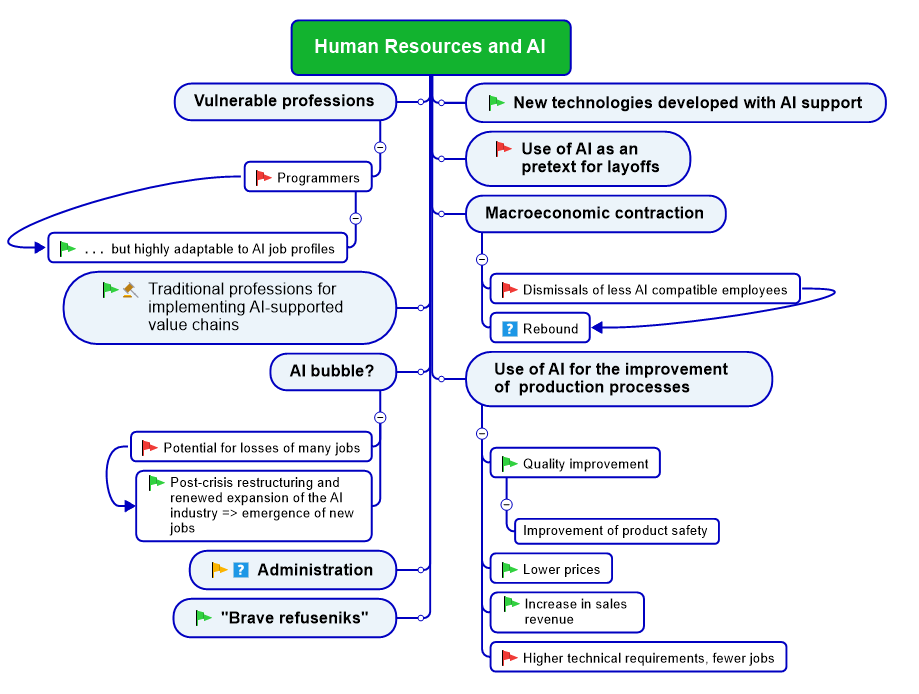
Overall, it can be said that the use of AI is merely continuing and accelerating a historical process. Now every citizen enjoys the benefits of being able to obtain useful information very quickly, but at the same time we fear the loss of jobs.
While there are valid reasons to suspect that some employers will use AI as an excuse to make redundancies, there is also evidence from history that while new technology does render some jobs obsolete, it also opens the market for a host of new ones.
The difference between this technological shift and the waves of innovation in recent decades lies in the unprecedented speed of structural change. Caution is therefore advised when making projections about the development of the labour market.
I read every letter. Whether you're a long-time reader or just found your way here, I will be interested in your opinion.
Join the public discussion. Respectful, pragmatic ideas are always welcome.
Your thoughts add value to the discussion.
No comments yet. Be the first to share your thoughts!
My name is Martin Bartels, and my journey has spanned the realms of law, sociology, banking, and asset management. After two decades in the financial sector, I embarked on a consulting career, enriching my expertise and perspectives.

The Evolution of Thinking Machines, as Opposed to that of Humans
When we compare the pace of human evolution with that of computers, it reveals that we are falling behind. Those who anticipate competition between humans and machines will struggle to argue for our continued superiority.
The Human Propensity to Treat the Invisible as Unimportant
The article describes how massive collective risks can build up and grow when organisations with a hierarchical structure decide to use ecosystems for the disposal of toxic substances. These risks are rooted in human nature and the way hierarchies function. But there are solutions.